How to choose the right worktop
Choosing a worktop is four decisions: material, thickness, edge profile and shape. We go through them through the factory's eyes — what withstands your use, what looks good and what is unnecessary. Finally, a checklist before measurement.
Where to start
Start from use, not from pictures. How many times a week is there serious cooking in the kitchen? Are hot pans put straight on the worktop? Are there children who spill juice and forget to wipe? Hard everyday use favours quartz or ceramic; gentle use allows marble or limestone, if you are prepared to care for it. Granite is the most carefree of the natural stones. You will also find the differences between the materials in our articles at our blog and our blog.
Then style and budget. A thick 30 mm worktop with a rounded edge looks traditional; thin 12 mm ceramic with a bevelled edge looks modern. The price is made up of the material, thickness, amount of machining and additional services — not just the square metre. Finally, care: all stone lasts when it is cared for according to the instructions (Maintenance and cleaning). Delivery and installation in Finland — 14 working days from drawing approval, whatever the material.
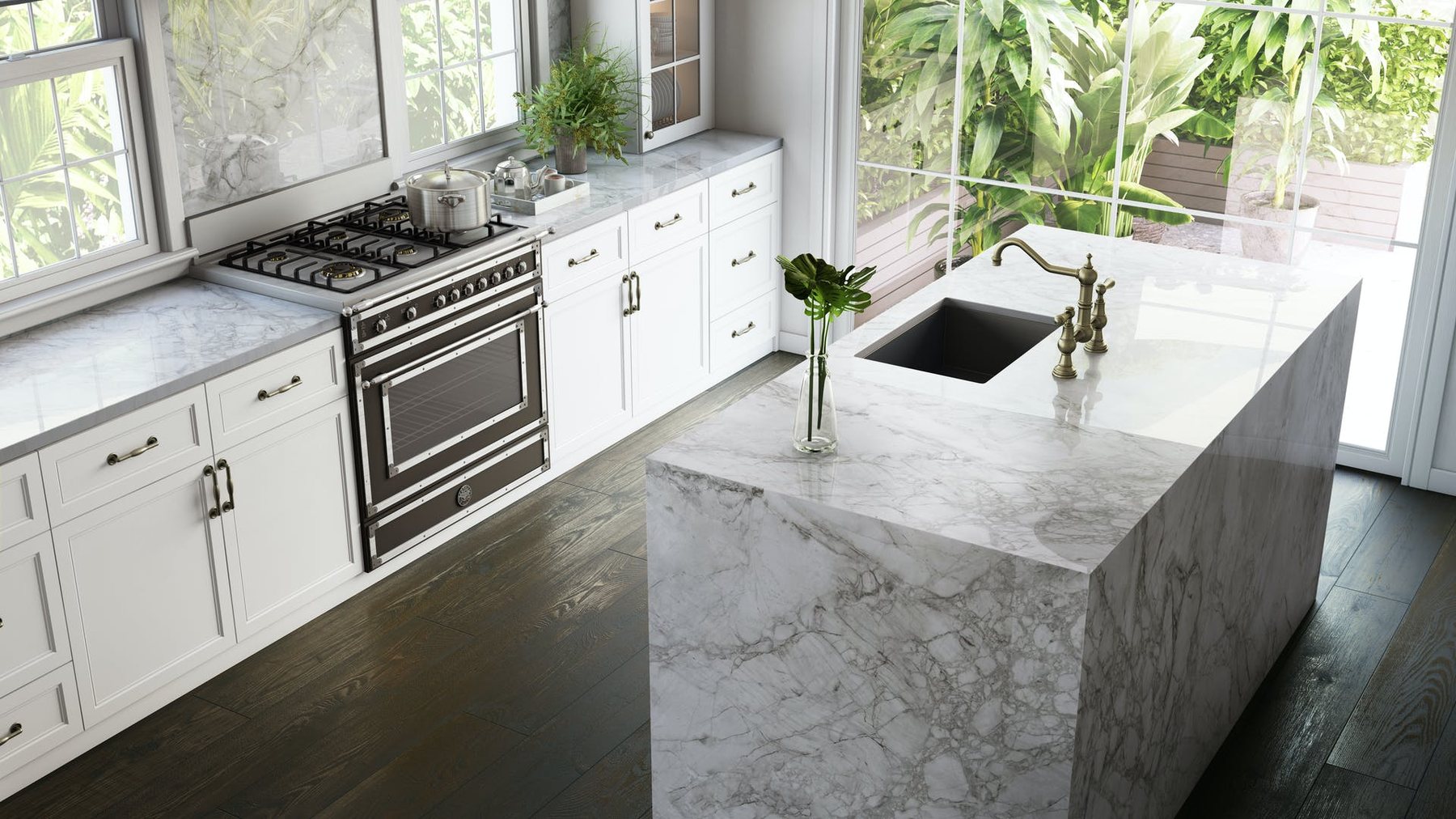
Materials compared
| Property | Quartz | Ceramic | Granite | Marble |
|---|---|---|---|---|
| Heat resistance | Good, but still use a trivet | Excellent, a hot pan is fine | Excellent | Good, but sudden temperature differences can leave a mark |
| Scratch resistance | Very good | Excellent, hardest surface | Very good | Moderate, a softer stone |
| Stain resistance | Excellent, dense surface | Excellent | Good when sealed | Sensitive to acids: lemon, wine, vinegar |
| Outdoor use | Not recommended, UV fades it | Yes | Yes | Limited, poor weather resistance |
| Maintenance | Minimal: water and mild detergent | Minimal | Sealing every few years | Regular sealing and care |
| Best suited for | Family kitchen, hard everyday use | Chef's kitchen, outdoor kitchen | Traditional kitchen, stairs, windowsills | Bathroom, representative space, gentle use |
Thickness: 12, 20 or 30 mm
Thickness affects the look, the weight and which edge profiles are possible.
12 mm — light and modern
Mainly ceramic. A thin line, a light slab, also suitable for splashbacks and as cabinet door surfaces. For the edge, a bevelled or glued edge that gives a thicker look.
20 mm — the most common choice
The standard thickness for quartz and ceramic. Stiff enough for overhangs, lighter than 30 mm, all edge profiles possible. A good default if there is no particular reason for anything else.
30 mm — solid and traditional
The classic for granite and marble, also available in quartz. A massive look, allows round and half-round profiles. Heavy — the carcasses must be in good condition.
Edge profiles
The edge decides how the worktop looks up close and how it withstands knocks. More at Edge profiles.
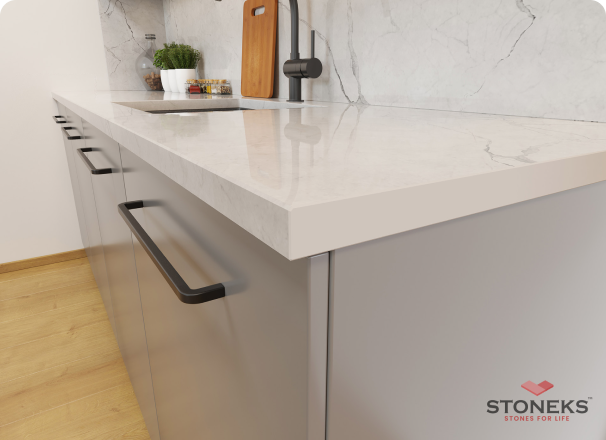
Bevelled edge
A small bevel on the top corner. Suits all thicknesses, especially 12 and 20 mm. Modern, easy to keep clean, protects the corner from chipping. Our most common choice.
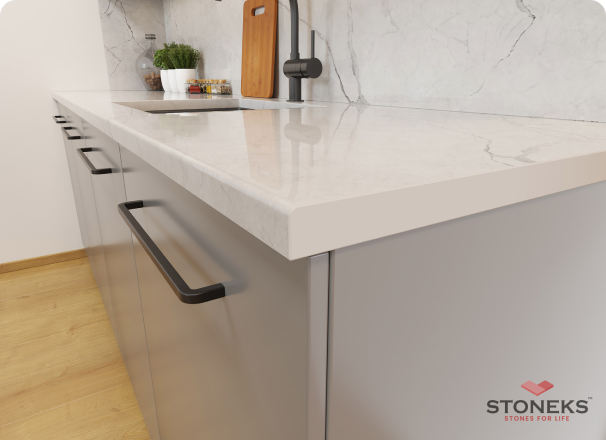
Rounded edge
Top corner rounded with a small radius. A softer look than the bevel, comfortable to the hand, withstands knocks. Suits 20 and 30 mm worktops in all materials.
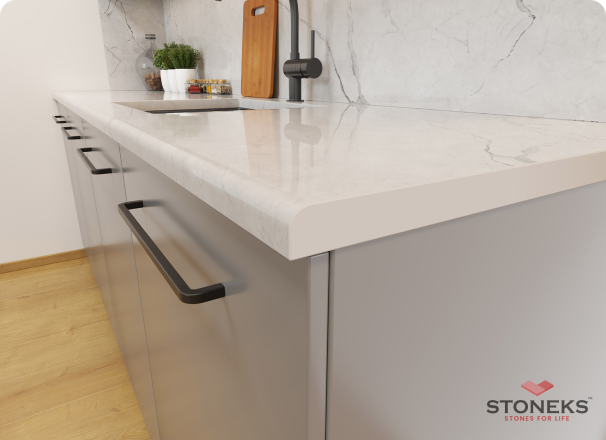
Half-round edge
Top edge rounded into a half-arc, bottom edge straight. A classic look for 30 mm granite and marble. Requires a thick slab; it does not fit on a thin one.
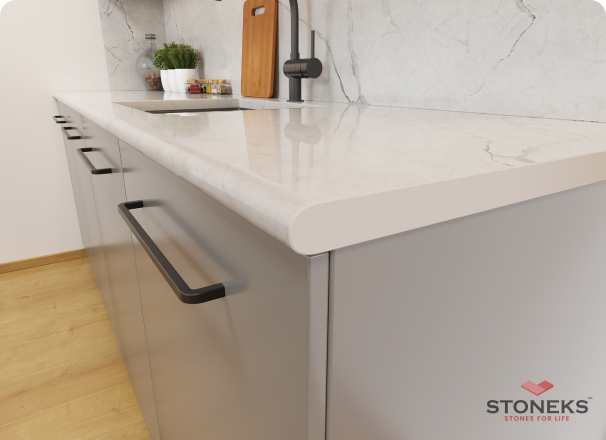
Round edge
The whole edge rounded into a full arc. The softest and safest — good for a family kitchen and islands. Only for 30 mm worktops. Traditional, does not suit thin modern lines.

Antique edge
A hand-split-looking, textured edge. Suits granite and a rustic style, also outdoor kitchens. The uneven surface collects more dirt; not for thin slabs or ceramic.

Glued edge
A strip of the same material is glued to the edge, so a 12 or 20 mm slab looks 40–60 mm thick. A massive look at a light weight. The joint is visible on close inspection.

Bevelled 15 mm
A wide 15 mm bevel that shows as a clear line of light on the edge. A graphic, architectural look for 20 and 30 mm worktops. Wears well, but the bevel stands out on light materials.
Worktop shapes
The shape determines the number and position of the joints — and how many slabs are needed.
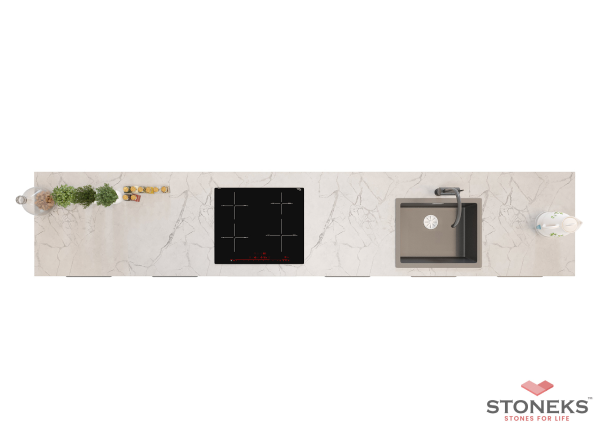
Straight worktop
One wall, one slab. Usually seamless when the length stays within the slab dimensions (about 3 m depending on the material). The simplest to measure and install; suits all materials and thicknesses.
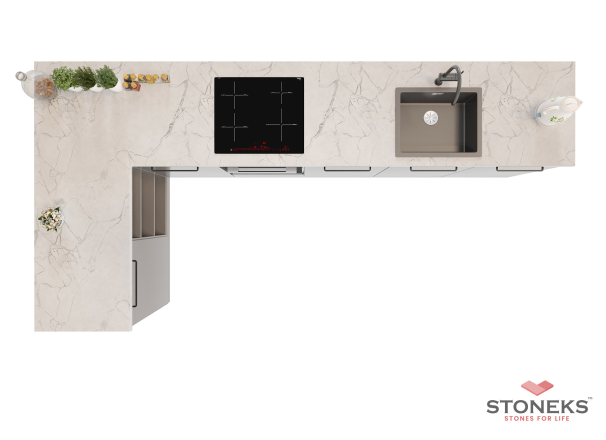
L-shaped corner kitchen
Two walls, one joint in the corner. We agree the position of the joint at the measurement — it can often be hidden at the sink or hob. The inner corner is always rounded so the stone does not crack.

Straight worktop and island
A wall worktop and a separate island. For the island it is worth choosing the same material and edge; the depth of the overhang decides whether support is needed. Two slabs, no corner joints.
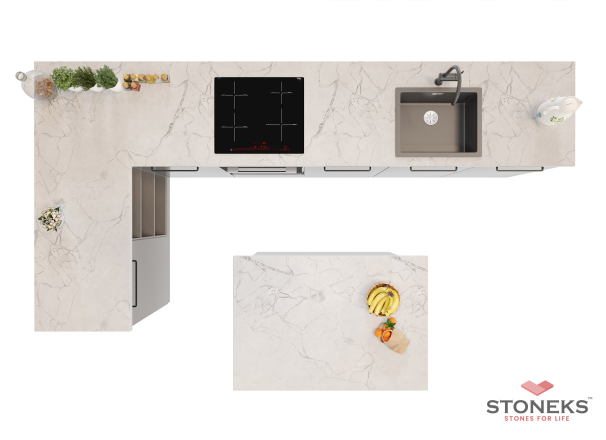
Corner kitchen and island
An L-shaped worktop plus an island — the typical open-plan kitchen. Three slabs, one corner joint. The island's edge profile is visible from every side, so choose it first and the wall worktop accordingly.
Island only
A free-standing worktop with all edges visible. Thickness and edge stand out; 30 mm or a glued edge looks solid. Remember electricity and water before the measurement.

U-shaped kitchen
Three walls, two corner joints. Requires precise measurement, because walls are rarely straight — hence the laser. The joints are positioned so that they are as unobtrusive as possible.

U-shaped kitchen and island
The largest configuration: four slabs, two corner joints and an island. The same material batch for all slabs so the shade stays uniform. Installation usually takes one longer day.
Sink and hob installation methods
The first four concern the sink, the last three the hob. Decide them before the measurement — the openings are milled at the factory.
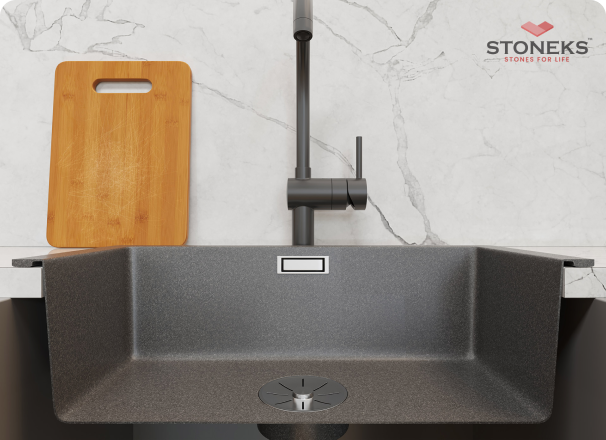
Top-mounted sink
The rim of the sink rests on top of the worktop. The easiest and most affordable, suits all thicknesses and almost all sinks. Dirt can collect under the rim; wipe the joint regularly.

Flush-mounted sink
The rim of the sink is milled into the surface of the worktop, so the rim sits level with the stone. Neat and easy to wipe. Requires precise CNC machining and a 20–30 mm worktop.

Undermounted sink
The sink is fixed to the underside of the worktop; the edge of the stone remains visible in the opening. The most popular for quartz and granite, as crumbs are wiped straight into the sink. The edge of the opening is polished.

Sink in the same stone
The sink is built from the worktop material and glued under the worktop — a seamless, uniform look. The most striking and the most demanding. Suits quartz and ceramic; ask about it separately.
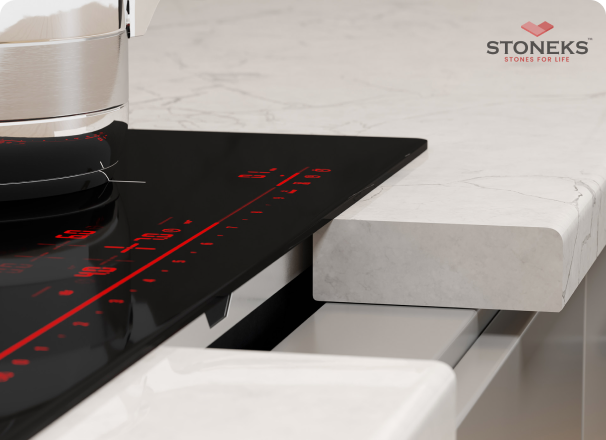
Top-mounted hob
The most common way: the frame of the hob rests on top of the stone. Suits all worktops and almost all hob models. The opening is milled according to the manufacturer's dimension drawing.

Flush-mounted hob
The glass of the induction hob is recessed level with the surface of the stone. Pans slide straight onto the worktop. Requires a hob model suitable for flush mounting and a worktop of at least 20 mm.
Tap and water fittings
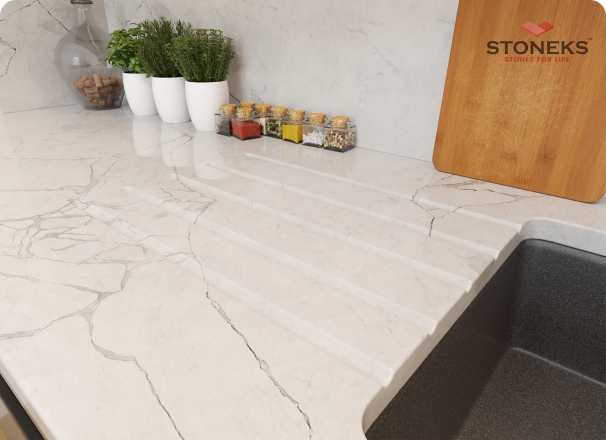
Tap holes, soap dispensers and sockets are drilled at the factory according to the dimension drawing. Tell us the models before the measurement — drilling on site afterwards is always a risk to the stone.
Checklist before measurement
Carcasses fixed and levelled
The cabinets are installed in their final position and level. We measure from the carcasses, not from the wall — if the carcasses move after the measurement, the worktop will not fit.
Sink, tap and hob known
Model and installation method decided; dimension drawings or the appliances on site. The openings are milled at the factory, so a change afterwards means a new slab.
Material and edge chosen
Stone, thickness and edge profile locked in the quote. It is worth seeing the material in person before the final decision — at our showroom you can view full-size slabs.
Walls and splashback clarified
Will there be a splashback in the same stone (Splashbacks)? Are there sockets in the walls whose positions matter? Tell the measurer and they will be drawn in.
Old worktop and extra work
We remove the old worktop, connect appliances and do plumbing work priced separately — agree them in advance so the installation is done in one visit.
Schedule
Delivery and installation in Finland — 14 working days from drawing approval. Make sure the kitchen is free on the installation day and the access route inside is unobstructed.
Frequently asked questions
What is the best material for a family kitchen?
For most, quartz: the dense surface does not absorb stains, withstands scratches and needs no sealing. If hot pans are put straight on the worktop or the kitchen is in hard use, ceramic is even more durable. Marble suits if you accept patina and care for the surface regularly. We help you choose: Request a quote.
Should I choose 20 or 30 mm?
20 mm is the standard thickness for quartz and ceramic: lighter, all edge profiles possible and stiff enough for ordinary overhangs. 30 mm is chosen for the look — traditional, solid — or when a round or half-round edge is wanted. A thin slab can be made to look thick with a glued edge if the massive look appeals but the weight does not.
Can the worktop be made without joints?
A straight worktop within the slab dimensions is seamless. In a corner kitchen the joint almost always goes in the corner, in a U-shaped kitchen in two. We position the joints at the measurement in the most unobtrusive places and make them with factory precision, so they are thin and in the shade of the material. Inner corners are always rounded so the stone does not crack — see Corner processing.
What if I do not yet know which sink I will take?
Decide it before the measurement, at the latest before the approval of the drawings. The opening is milled at the factory according to the sink's dimension drawing, and it cannot be enlarged safely on site. If the sink is still open, see our options at Sinks and taps — at the same time we make sure the sink and installation method suit the chosen stone.
How quickly is the worktop ready?
Delivery and installation in Finland — 14 working days from drawing approval. The time starts once the measurement is done and the drawings approved. For special-order goods the delivery time may be longer; we tell you in the quote. The whole flow from quote to installation is described at Ordering.
Unsure about the choice? Ask us
Tell us your use and style — we suggest the material, thickness and edge and make a quote. Contact: Contact us.

