Choose the right edge profile for your stone worktop
The edge profile is the most visible detail of the worktop and the part that hands, dishes and children bump into every day. Here we go through our seven profiles, tell you which thickness each one suits and what is worth knowing about the machining.
Why the edge profile decides more than you might think
The edge is the only place where the thickness of the stone shows and where the stone is exposed to impacts. A sharp 90-degree corner looks precise, but if a pan knocks against it, a small chip is more likely than on a rounded edge. Quartz and granite are very durable, but it is in the nature of stone that stress is released at the thinnest point. That is why at our factory at least a small bevel is milled on every edge, even if you order a straight edge.
The second reason is cleaning. A rounded or bevelled edge does not collect dirt in the joint between the worktop and the front strip, and when wiping, the cloth glides over the edge. The third reason is style: a narrow bevel suits a modern kitchen, half-round and antique edges a more traditional one. The fourth is safety, especially on a kitchen island whose edge a child or a hip bumps into when passing. Below we go through the profiles one at a time.
Our seven edge profiles
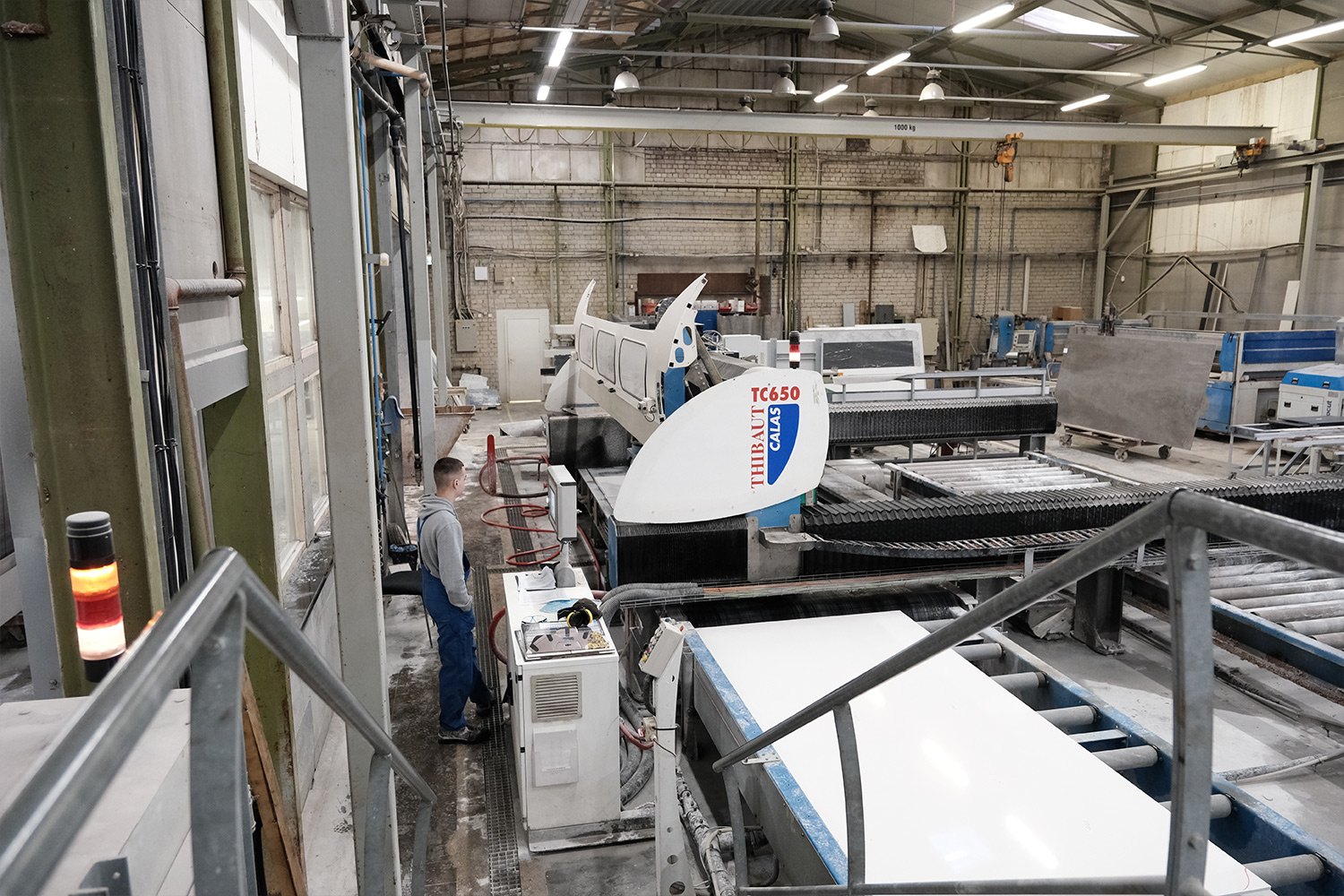
All profiles are milled on a CNC machine at our own factory in Estonia and polished to the shade of the surface.
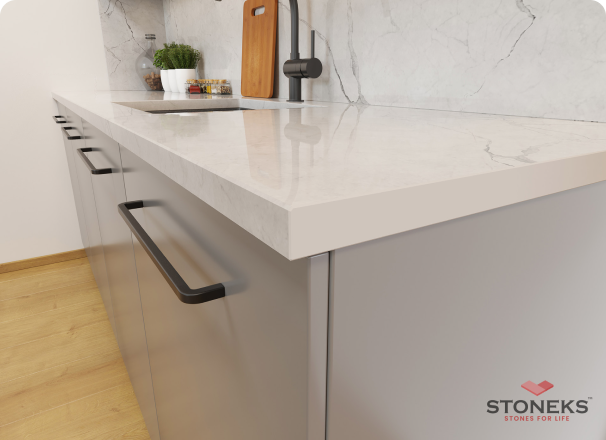
Bevelled (2–3 mm bevel)
Our most common choice and a good default for almost everything. A small bevel on the top and bottom edge protects against chipping and keeps a straight, modern look. Suits 12, 20 and 30 mm thicknesses as well as ceramic.
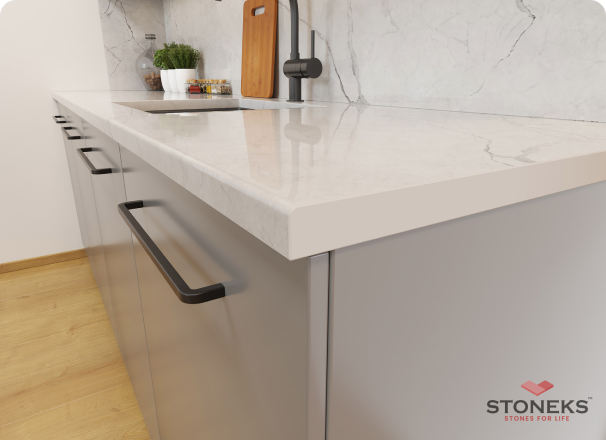
Rounded (R 3–5 mm)
The top edge is rounded with a small radius. Comfortable to the hand, easy to wipe and withstands knocks better than the bevel. Works on 20 and 30 mm slabs; on 12 mm ceramic the radius remains imperceptibly small.
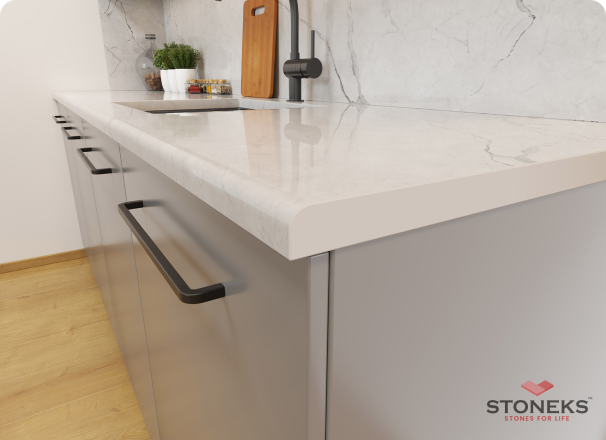
Half-round
The top edge curves over the whole thickness, the bottom edge remains straight. A soft profile that sits well in a traditional and country-style kitchen. We recommend 20 or 30 mm thickness so that the curve stands out.
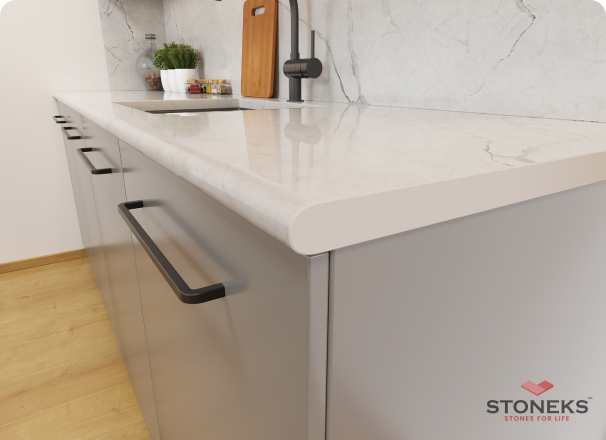
Round (full rounding)
The edge is rounded both from the top and the bottom, creating an arc over the whole thickness. The safest option for a family with children and for islands. Requires 30 mm thickness or a glued edge; on a thin slab the shape disappears.

Antique
A profiled, decorative edge for a classic kitchen or an old house. Looks best on granite and marble at 30 mm thickness. More grooves to clean and the machining takes more time, which shows in the quote.

Glued edge (thickened)
A strip of the same stone is glued under the front edge, so a 20 mm slab looks 40 mm thick. Striking and more affordable than a real solid slab. Done carefully, the joint is almost invisible; in a patterned stone it may stand out.

Bevelled 15 mm
A wide 45-degree bevel that makes the edge a clear design element. Popular in dark quartz and ceramic, where the surface of the bevel reflects light. Requires at least 20 mm thickness, at its best on a 30 mm slab.
Which profile for which thickness
| Profile | Suitable thickness | Style | Note |
|---|---|---|---|
| Bevelled | 12 / 20 / 30 mm | Modern, neutral | Fastest to machine; also works on ceramic |
| Rounded | 20 / 30 mm | Modern, soft | Most resistant to everyday knocks |
| Half-round | 20 / 30 mm | Traditional | The curve only shows from 20 mm upwards |
| Round | 30 mm or glued | Classic, safe | Not for 12 mm slabs |
| Antique | 30 mm | Classic, decorative | The grooves require more careful wiping |
| Glued edge | 20 mm + strip | Massive look | The joint is most visible in patterned stone |
| Bevelled 15 mm | 20 / 30 mm | Design, graphic | The bevel surface shows the shade of the stone's cut face |
How the decision is made with us
The edge profile is chosen at the quote stage and confirmed in the drawings after the measurement. If you are not sure, our measurer shows sample pieces of the different profiles on site, and you can feel them in your hand. At the same time, tell us where in the worktop there is an island edge or a walkway, so that we recommend the right radius and corner treatment. Once the drawing is approved, the slab is machined at our own factory and installed by our team. Delivery and installation in Finland — 14 working days from drawing approval. We cover corner rounding separately at Corner processing, and choosing the whole worktop at Choose the right worktop.
Frequently asked questions
Does the edge profile affect the price?
Yes, but rarely decisively. The bevelled and rounded edges are included in normal machining. Half-round, round and antique require several milling passes and polishing, and the glued edge adds material and handwork. We itemise the profile as its own line in the quote, so you see the effect directly before deciding.
Can different edges have different profiles?
Yes. A common solution is a rounded or round edge on the walkway side of the island and a bevelled edge next to the wall. We mark the profiles edge by edge in the drawing, and the CNC machining makes them exactly according to the drawing. Tell us your wishes already in the quote request and we suggest a combination.
Does ceramic take the same profile as quartz?
Not quite. Thin 12 mm ceramic is most often machined with a small bevel or a glued edge, which gives it a more massive look. Larger roundings do not show on a thin slab or weaken the edge. On 20 mm ceramic the range is wider. We suggest a profile suitable for the material in the quote.
Does the edge show a different colour from the surface?
On polished quartz and granite the edge is polished to the same gloss as the surface, so the shade is the same. In ceramic and some surface-patterned quartzes the core of the slab is a different shade from the surface layer; then a wide bevel or the cut face of the edge stands out slightly. We show this on a sample piece before ordering.
Can a chipped edge be repaired?
Small chips in quartz and granite can often be filled with tinted resin and polished on site. Larger damage requires replacing the slab. Our warranty covers defects resulting from installation and manufacture, not chips caused by impacts — see Warranty and care instructions at Maintenance and cleaning.
Request a quote and mark your preferred edge profile
Tell us the material, estimated size and edge profile, and we send a quote within 24 hours on working days. Delivery and installation in Finland — 14 working days from drawing approval.

