Choose the right corner treatment for your stone worktop
The radii of the outer and inner corners affect the durability, safety and appearance of the worktop more than many would guess. We explain when a small radius is enough, when it is worth rounding more generously and why the inner corner is always rounded.
Why corners are worth planning in advance
A stone worktop has two kinds of corner. The outer corner is the one that projects into the room — the end of an island or a straight worktop. The inner corner arises in an L- or U-shaped worktop where two worktops meet, or in the sink and hob cut-outs. With the outer corner the question is safety and susceptibility to chipping: a sharp corner is felt in the hip and chips more easily from a knock. A small rounding, radius under 100 mm, removes both problems almost imperceptibly.
The inner corner is more critical for the material. During transport, installation and temperature changes the stone is subject to stresses that seek out the sharpest point. A sharp 90-degree inner corner is in practice the beginning of a crack, and that is why at our factory every inner corner is milled with a radius — at least 5–10 mm, in visible corners often more. This is not a matter of style but a condition for the worktop lasting for years. Below are the radii and images for both corner types.
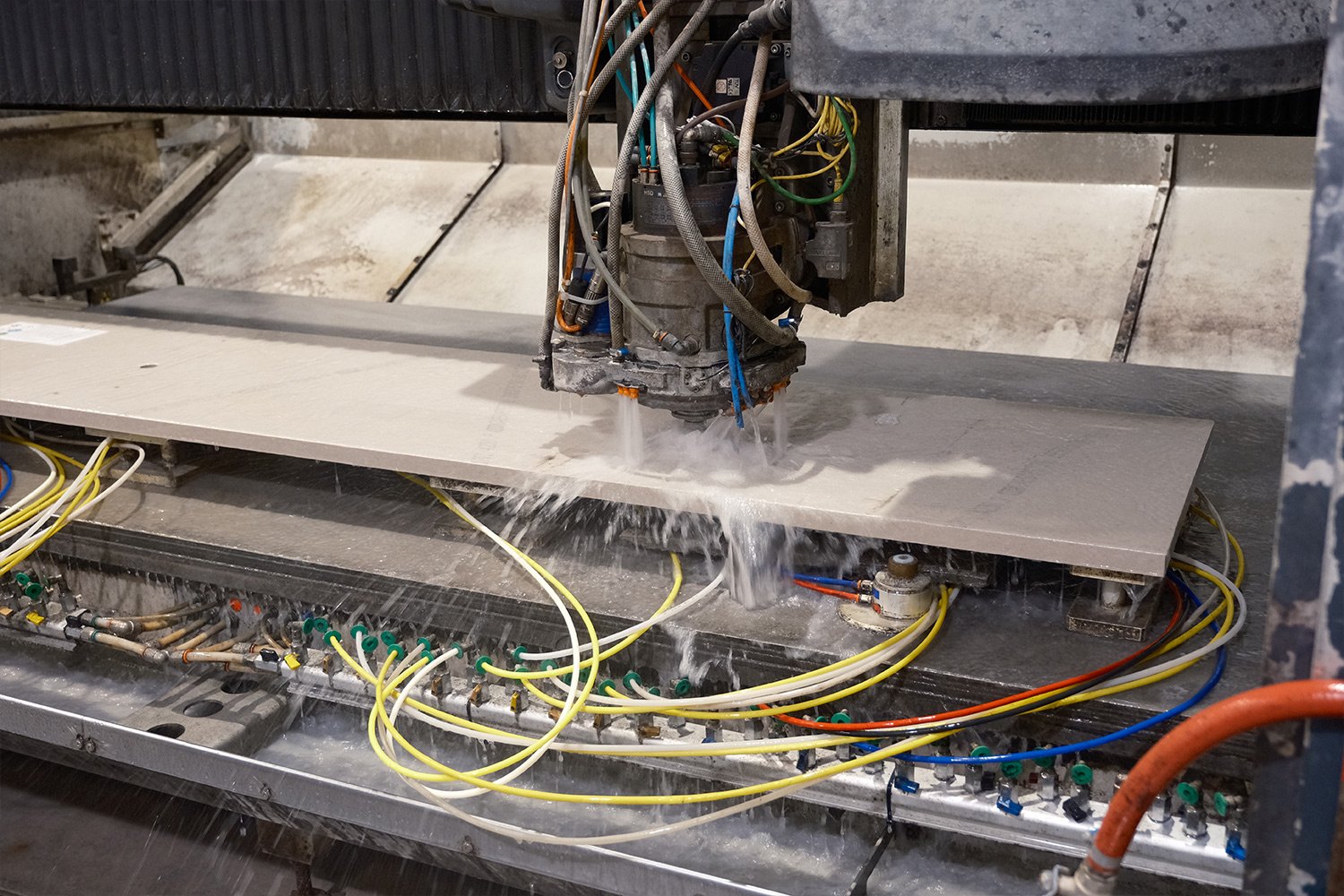
Corner treatments by radius
Radius R means the radius of the arc of the rounding in millimetres. All corners are milled on a CNC machine according to the drawing.

Rounded corner 0–100 mm
A small radius on the outer corner. Removes the sharp point, keeps the straight look and protects against chipping. Suits all thicknesses and is our default for worktop ends next to a wall and for narrow islands.
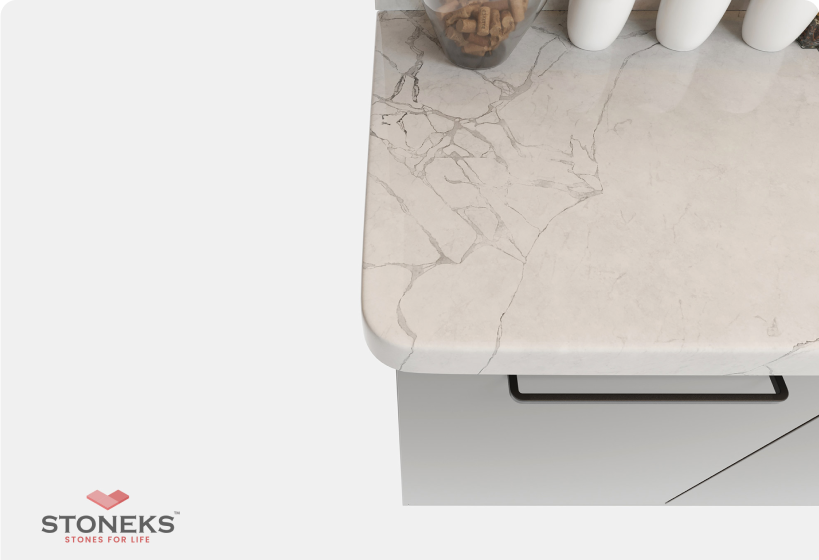
Rounded corner 101–300 mm
A clearly visible arc that softens the end of an island or a bar top. Good for a family with children and for the corner facing a walkway. Takes a little worktop area from the corner, so consider where the arc falls in relation to stools and cabinets.
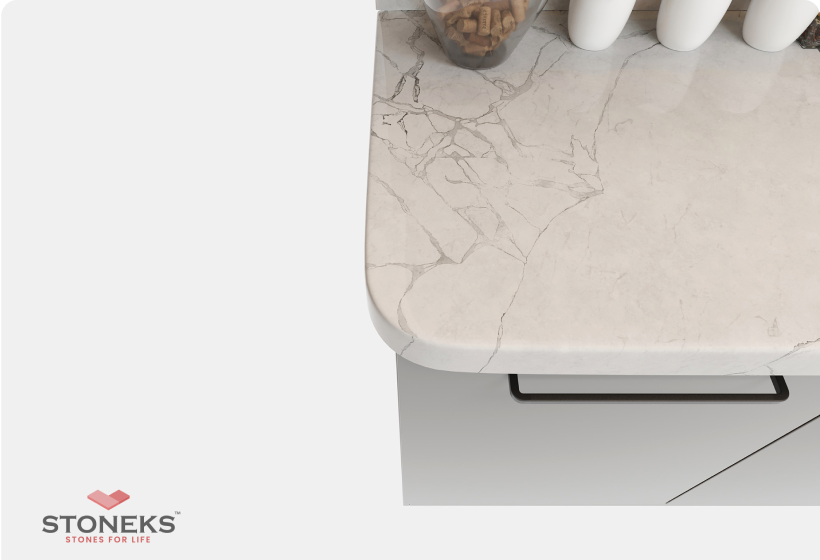
Rounded corner R > 300 mm
A large arc or a fully rounded worktop end. A design choice for an island, a breakfast table or a bathroom worktop. Requires a precise drawing and more slab as offcut. A rounded or round edge profile suits it.

Inner corner 0–100 mm
Our standard treatment for the inner corners of L- and U-shaped worktops and for sink and hob openings. A small radius releases the stress and is barely visible. Without this rounding we do not manufacture the worktop — it is a basic condition for the durability of the stone.
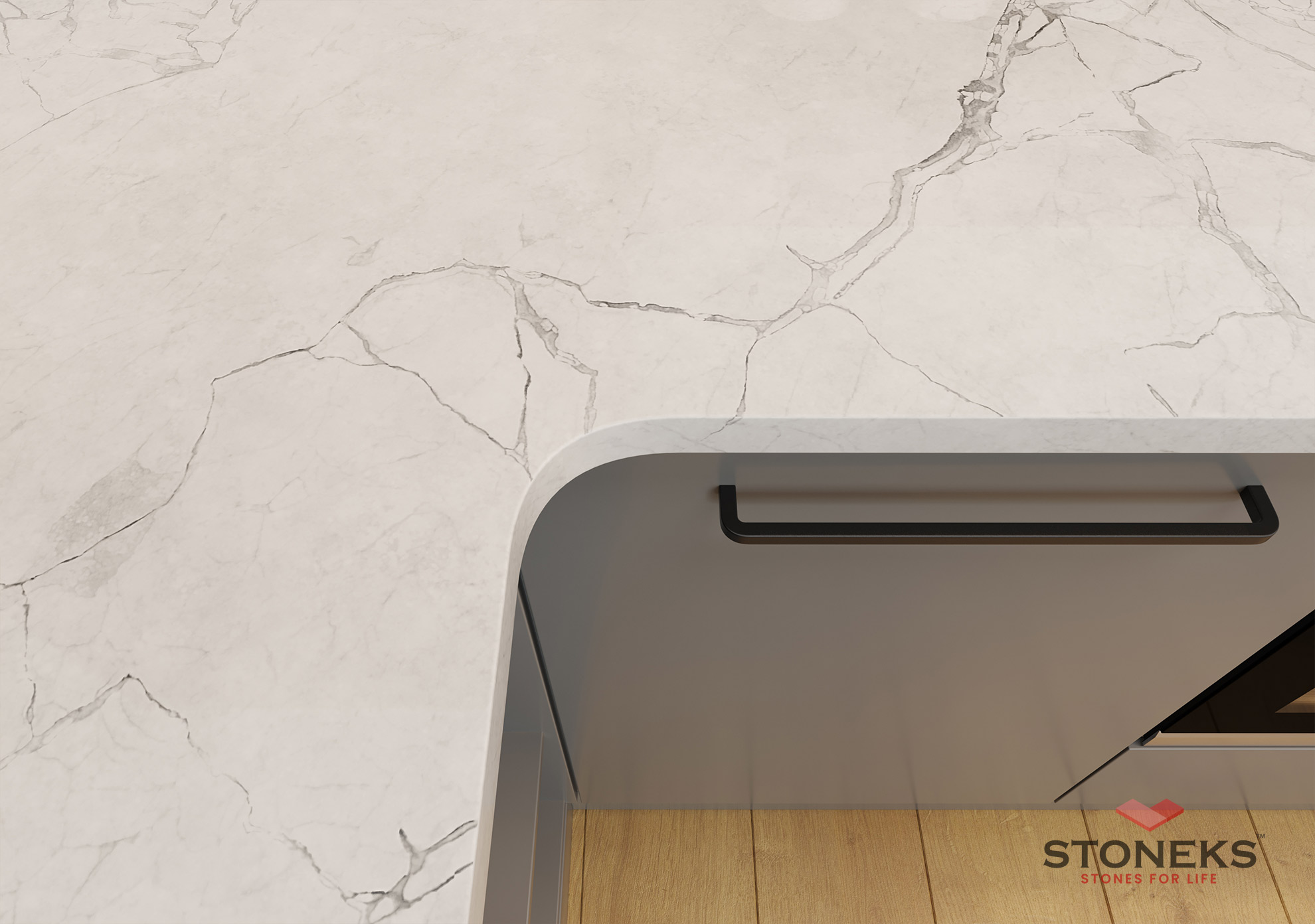
Inner corner 101–300 mm
A visible rounding on the inner corner, for example when the worktop wraps around a wall or a pillar or when an open shelf comes into the corner. Makes wiping easier, because the cloth does not get caught in sharp corners. The cabinet carcasses must follow the same arc.

Inner corner R > 300 mm
A large arc on the inner corner, in practice an organic worktop shape. Used in special projects, bathrooms and counters. Always designed together with the furniture designer, because the carcasses, plinth and splashback follow the arc.
When to use which radius
The rules of thumb our measurers use when suggesting a corner treatment.
Worktop end next to a wall
A small outer corner radius of 0–100 mm is enough. The corner is rarely on a walkway, and a small rounding prevents chips when moving appliances or drawers.
Island and bar top
101–300 mm or more on the outer corners. The corners are in the middle of the room and at children's head height. A larger radius is safer and looks natural on an island.
L- and U-shaped worktop
The inner corner is always rounded with a radius of at least 0–100 mm. For a visible inner corner you can choose a larger radius if the cabinetry supports the same shape.
Sink and hob openings
The inner corners of openings always get a radius, as they are the weakest point of the worktop. With top-mounted sinks the radius hides under the rim of the sink; with flush-mounted ones it is visible and rounded neatly.
Bathroom and counter
In a wet room sharp corners get knocked and collect limescale. A rounding of 101–300 mm or a free arc cleans more easily and is safer in a tight space.
Ceramic 12 mm
Thin ceramic is rigid and chips from a sharp corner more easily than quartz. We recommend a more generous radius for inner corners and at least a small rounding for outer corners.
How corners are marked in the order
The measurer goes through the corners on site during the laser measurement and marks a radius for each corner. After the measurement you receive a drawing in which every corner and radius is marked in figures — check it at your leisure, because production is done exactly according to it. Once you approve the drawing, the slab is milled on a CNC machine at our own factory and the same team installs it. Delivery and installation in Finland — 14 working days from drawing approval. We cover edge profiles at Edge profiles, and how the measurement goes at Measuring and installation.
Frequently asked questions
Can I have a completely sharp outer corner?
On the outer corner we can mill a very small radius that looks sharp but does not chip as easily. We do not recommend a corner left completely sharp, because even a small knock shows immediately and our warranty does not cover chips caused by impacts. On the inner corner we do not make a sharp corner at all, for the sake of the material's durability.
Does the inner corner rounding show on an L-shaped worktop?
With a small radius of 0–100 mm it is practically invisible, because the corner is usually in the corner of the wall and the splashback. If the two parts of the L-shaped worktop are joined with a joint, the joint is made at the inner corner and the rounding falls between the pieces. Larger radii are a deliberate design choice.
Does the corner radius affect the price?
Small radii are included in normal machining. Large radii and free arcs add programming and milling time as well as slab waste, which shows in the quote as its own line. Tell us your wishes in the quote request and you see the effect directly before deciding. In practice a rounding is almost always a smaller cost item than changing the material.
Do the cabinet corners have to match the worktop radii?
On outer corners the worktop usually overhangs the cabinet edge by 20–40 mm, so a small radius requires nothing of the cabinetry. Radii over 100 mm should be coordinated with the cabinetry so that the overhang stays even. For large inner corners the carcasses must follow the arc, and that is agreed with the furniture designer.
How do I measure the radius myself in advance?
You do not need to. Our measurer measures the site with the laser and suggests the radii, but if you want to visualise it, draw an arc with the desired radius on cardboard and place it in the corner of the cabinet. A radius of one hundred millimetres corresponds to the size of the arc drawn with a compass with a 10 cm arm. You confirm the radii in the drawing.
Ask for the right corner treatment for your kitchen
Send a floor plan or a photo of the kitchen and we suggest the radii and profiles in the quote. We reply within 24 hours on working days.

