Quartz or Granite? An Installer’s View from 13,000 Projects
Quartz or granite is a question that comes up at almost every measurement visit. Both are stone countertops, but they behave differently in fabrication, installation and everyday use. We have fabricated and installed both at our own factory for over 20 years and across more than 13,000 projects. Here is where the difference actually shows: on the machine, in the edge profile, at the seam and in the moment a hot pan lands on the kitchen counter. At the end you will find a clear decision tree and the four questions we hear most often.
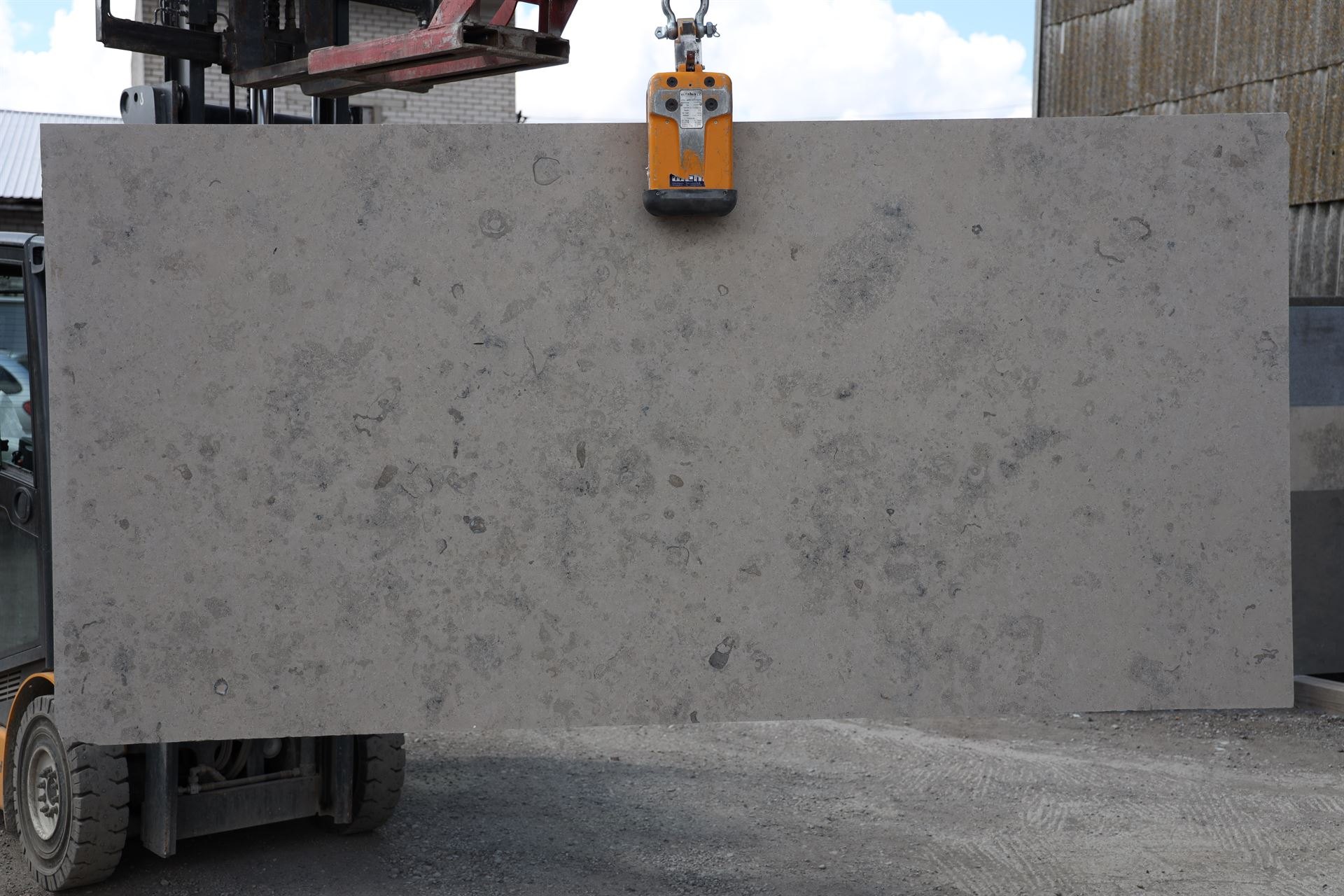
Where does the difference show already at the factory?
Quartz composite is an engineered slab. Colour and density repeat from slab to slab, so CNC fabrication is predictable and cut-outs land to the millimetre. Granite is natural stone, and every slab is an individual: hardness, veining and tone vary even within the same name. That is why in a granite project the slab is selected from stock by name and the pattern layout is planned before cutting.
- Quartz countertop: the colour stays identical even when the kitchen needs several slabs.
- Granite countertop: the veining flows across a seam only if the slabs are selected and laid out together.
- In both, the cut-outs, sink mounting and hob recess are machined before transport — not in your kitchen.
Quartz or granite — what does the comparison table say?
| Property | Quartz composite | Granite |
|---|---|---|
| Everyday durability | Dense, consistent slab that stands up well to daily use | Hard natural stone, wear-resistant; hardness varies by stone type |
| Heat | Do not place hot cookware directly on the surface; use a trivet | Handles heat well, though a trivet is still a sensible habit |
| Scratches | Good scratch resistance, but keep using a cutting board | Good scratch resistance; marks show more readily on dark polished surfaces |
| Stains and care | Non-porous, no sealing needed; mild detergent is enough | Porous; sealing is recommended and repeated periodically |
| Appearance and colours | Repeatable colour, including pale solid tones; avoid constant direct UV light | Every slab is unique, with natural veining and depth |
| Applications | Kitchen, bathroom, utility room, indoor spaces | Kitchen, fireplace surrounds, places with a lot of heat |
| Thicknesses | Most commonly 20 and 30 mm; the edge can be built up by laminating | Most commonly 20 and 30 mm |
| What drives the cost | Series and colour, number of slabs, edge profile, number of cut-outs, machining time | Stone type and slab availability, pattern layout, amount of fabrication and finishing |
Why do the edge and the seam decide the result?
The material choice rarely shows in the middle of the surface. It shows at the edge and at the seam. In quartz composite the edge profile is ground smooth and the colour stays consistent across the edge face, so both a straight edge and a rounded profile sit well. In granite the edge tone often deepens with polishing, and that is worth knowing in advance if your kitchen has a large island.
Seams are always placed on the drawing, never on installation day. A seam goes preferably at the sink or along a cabinet joint line, not in the middle of a work area. With granite we also make sure the pattern flows naturally across the seam.
Can the countertop take a hot pot?
This is the most common misconception we correct at installation. Granite naturally handles heat well. Quartz composite contains a binder, so an oven dish or a hot pan should never go straight onto the surface: use a trivet, especially next to the hob and the oven. The same applies to freezing temperatures and constant direct sunlight — a quartz countertop belongs indoors.
Does the countertop need sealing?
Quartz composite is non-porous and is never sealed. Granite is natural stone and absorbs moisture, so sealing is recommended and repeated periodically depending on use. In practice the difference is a few minutes a couple of times a year. At installation we tell you what your particular stone needs and leave a care guide in the kitchen.
Which to choose? A decision tree from the installer’s desk
- Choose a quartz countertop if you want a consistent colour, a pale solid-colour surface or carefree maintenance with no sealing — and you can live with a trivet. See our quartz countertops.
- Choose a granite countertop if you want the living pattern of natural stone, often set hot cookware on the counter or want a top where every slab is one of a kind. See our granite countertops.
- Undecided? Bring your kitchen measurements and cabinet colour, and we will pull two options side by side from our material selection. We keep more than 100 stone materials in stock.
How does the project run from measurement to installation?
We measure your kitchen on site, fabricate the slab on CNC machines at our own factory and install it in your home. The same team handles the chain from start to finish, and you have one contact person. Removal of the old countertop, appliance installation and electrical and plumbing work are available from us when needed, priced separately. Check the current details on vero.fi. The steps are described in how to order.
Summary
A quartz countertop is a consistent, carefree choice that needs no sealing but will not take hot cookware directly. A granite countertop handles heat and brings the living pattern of natural stone into the kitchen, but it is sealed periodically and every slab is an individual. We have our own factory in Estonia, so the same team measures, fabricates and installs. Delivery and installation in Finland — 14 working days from drawing approval.
Frequently asked questions
How quickly can I get a stone countertop in my kitchen?
Delivery and installation in Finland — 14 working days from drawing approval. The schedule is agreed at the measurement, and you get one contact person who keeps you up to date from fabrication to installation.
Which costs less, quartz or granite?
Both groups span several price tiers, so the material alone does not decide it. The total depends on the number of slabs, thickness, edge profile, number of cut-outs and machining time. We fabricate the slabs at our own factory with no reseller margin and quote based on your measurements.
Can I put a hot pot straight on the countertop?
Granite handles heat well, but hot cookware should never go straight onto quartz composite. We recommend a trivet with both, because it extends the life of the surface near the hob and the oven.
Do you handle removal of the old countertop?
Yes. Removing the old countertop, installing appliances and the electrical and plumbing work are among our additional services, priced separately. Mention what you need when booking the measurement and we will reserve the right amount of time for the installation.
Want to know which one suits your kitchen? Request a quote — we will go through the measurements, the material and the schedule in one go.
FAQ
How quickly can I get a stone countertop in my kitchen?
Delivery and installation in Finland — 14 working days from drawing approval. The schedule is agreed at the measurement, and you get one contact person who keeps you up to date from fabrication to installation.
Which costs less, quartz or granite?
Both groups span several price tiers, so the material alone does not decide it. The total depends on the number of slabs, thickness, edge profile, number of cut-outs and machining time. We fabricate the slabs at our own factory with no reseller margin and quote based on your measurements.
Can I put a hot pot straight on the countertop?
Granite handles heat well, but hot cookware should never go straight onto quartz composite. We recommend a trivet with both, because it extends the life of the surface near the hob and the oven.
Do you handle removal of the old countertop?
Yes. Removing the old countertop, installing appliances and the electrical and plumbing work are among our additional services, priced separately. Mention what you need when booking the measurement and we will reserve the right amount of time for the installation.
Want a fixed price for your stone countertop? Send us your measurements or a photo of your kitchen — we reply within 48 hours. Delivery and installation in Finland — 14 working days from drawing approval.

